Data-driven design
Prototyping
Changing hearts & minds

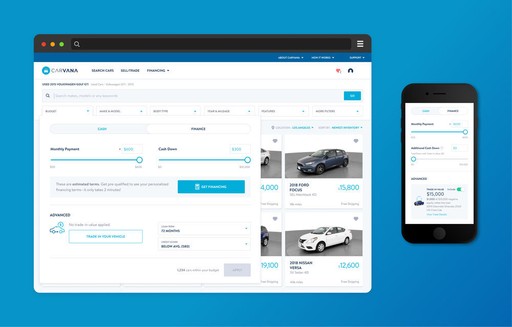
This is a story of how I convinced a PM to do the thing that took longer but was better for customers
The product manager on the Search team was a highly intelligent founder of a startup that had been acquired by Carvana. He suggested that we stick a module at the top of the Search Engine Results Page that threw up different ways to narrow down a car search.
I knew that users weren’t going to be expecting a bunch of information thrown at them when they are already mid-task.
With the help of supporting analytics and a collaborative mindset, I was able to turn what may have been a shoehorned solution into what was really needed – an overhaul of the facets set on the Search Results Page.
Results: Within the first 2 weeks the new filters resulted in:
+5.28% increase in vehicle trade-ins
+2.81% increase in financing applications
+1.8% increase in purchase funnel conversions
Nothing the PM was suggesting really felt right to stick on top of a search results page.
I am all about proving myself wrong, so I did make a few versions of a module to sit at the top of the Search Results Page.
However, none of the versions tested particularly well during qualitative sessions. Not terrible, but not great. I just knew we weren’t going to hit this out of the park with the current solution direction.
It felt like we should take a moment and step back, so I partnered with Carvana’s killer analytics team in order to take an independent look at the usage analytics of the page.
I made a case to instead devote engineering resources to updating the facets before jumping the shark on a module that takes away from the core function of this surface.
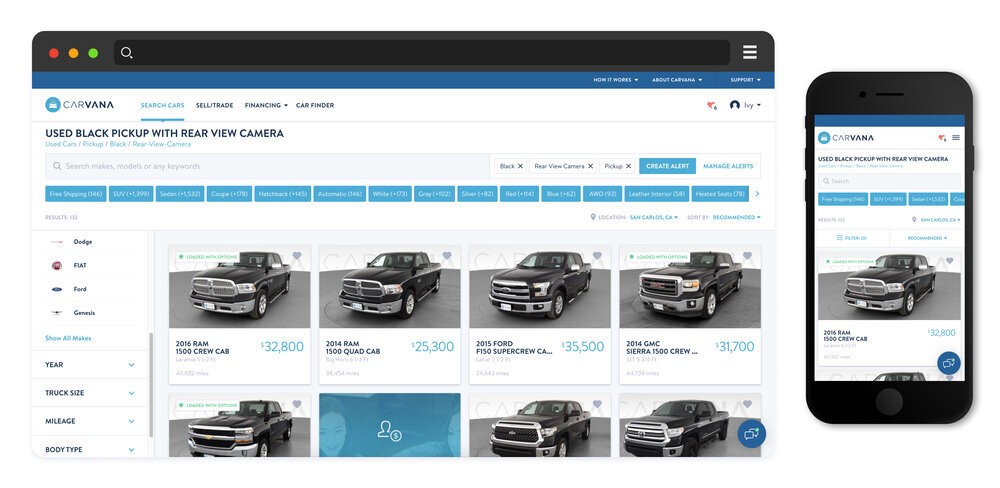
Old filters, prioritizing make and model over finance filters.
I double-downed on our core audience, lower income or payment sensitive car shoppers.
As a business, Carvana makes the largest margin off lower priced cars as these customers usually also choose Carvana vehicle financing.
I recently had conducted ethnographic interviews around Los Angeles, CA and Phoenix, AZ to more fully develop a UX persona of our biggest customer group, the “Finance-first” segment. These are people most concerned about budget related things like monthly payment and cash down. The needs of this group were top of mind for me when designing these facets.
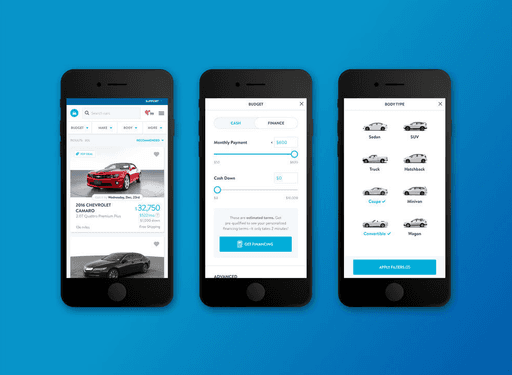
We also knew that catering to this segment was a huge initiative on behalf the the company. We made sure to spend extra care redesigning the Budget filter to make sure that people were seeing cars they could safely afford.
While conducting a large ethnographic study of finance-first customers, I heard first hand that affordability was more important than any other car feature.
We focused on helping the user set up all their financial info to get the most accurate predictions of final cost, including allowing shoppers to add their trade-in value.
I used data to prioritize filters by usage.
Both a qualitative user study and the cold-hard analytics supported budget filters as being the most important to car shoppers on Carvana. The current filters on the search page didn’t seem to match up to consumers mental model at all.
The data pull from analytics of filter usage also followed closely to the qualitative info. We reordered the facets based on the findings.
Finance filters
Make & Model
Body type
The rest
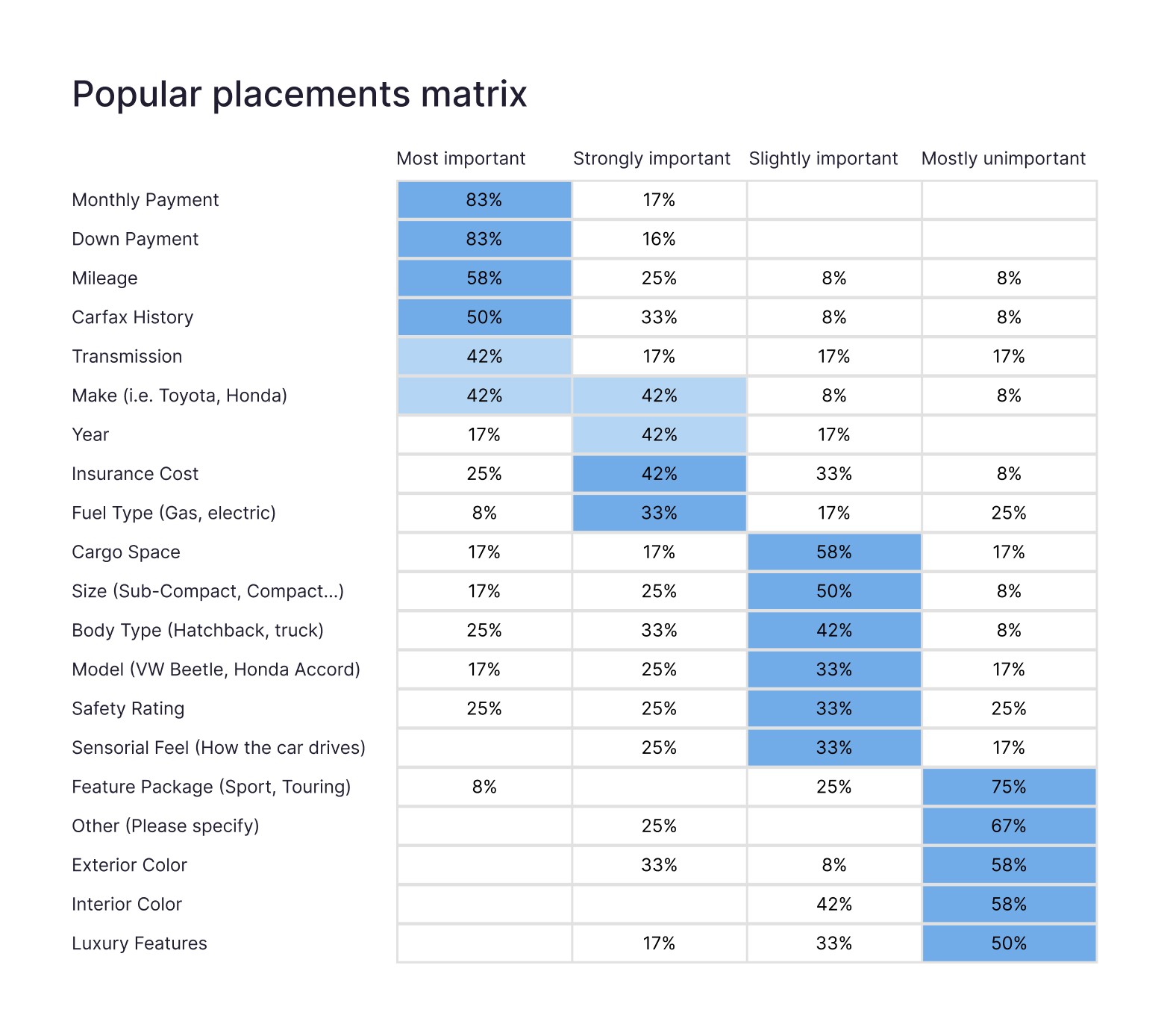
Below, 83% of participants rated Affordability and Price as Most important in a card sort.
I looked at the problem, not the solution.
I love telling the story of this project because it’s a perfect example of how taking a step back and gathering the right data can cause the business to favor better experiences on more than just visuals alone.
Rather than working against business needs design needs to cater to them to get the results.
Let's doooooo it
I'm looking for teams with AI-fluent workflows and products
where AI is core to the experience, not a checkbox.